How many countries in Asia were visited by at least one of Dheeraj, Samantha and Nitesh?
Solution
Asia: China plus Dheeraj's 2 others: .
Answer: 3
Overlapping groups and counts that are easiest with a Venn diagram.
Appeared in 5 of 18 slots. Most recent: CAT 2024 Slot 1.
| Year | Slot 1 | Slot 2 | Slot 3 | Sets |
|---|---|---|---|---|
| CAT 2025 | 0 | 0 | 0 | 0 |
| CAT 2024 | 1 | 0 | 0 | 1 |
| CAT 2023 | 0 | 0 | 0 | 0 |
| CAT 2022 | 1 | 1 | 0 | 2 |
| CAT 2021 | 0 | 0 | 0 | 0 |
| CAT 2020 | 2 | 0 | 1 | 3 |
| Total | 4 | 1 | 1 | 6 |
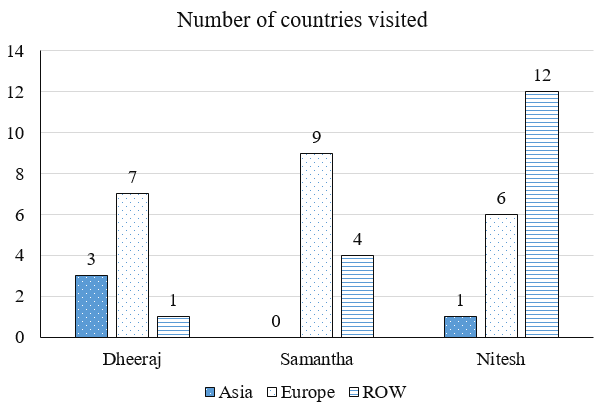
The chart below provides complete information about the number of countries visited by Dheeraj, Samantha and Nitesh, in Asia, Europe and the rest of the world (ROW).
The following additional facts are known about the countries visited by them.
1. 32 countries were visited by at least one of them.
2. USA (in ROW) is the only country that was visited by all three of them.
3. China (in Asia) is the only country that was visited by both Dheeraj and Nitesh, but not by Samantha.
4. France (in Europe) is the only country outside Asia, which was visited by both Dheeraj and Samantha, but not by Nitesh.
5. Half of the countries visited by both Samantha and Nitesh are in Europe.
Visits: Dheeraj (Asia 3, Europe 7, ROW 1), Samantha (0, 9, 4), Nitesh (1, 6, 12).
All three: only USA (ROW). Dheeraj–Nitesh only: China. Dheeraj–Samantha only (outside Asia): France.
Asia: Nitesh's one country is China; Dheeraj has China plus 2 more: 3 countries.
Europe: Dheeraj has France plus 6 of his own. Let Samantha–Nitesh overlap be in Europe and in ROW (including USA); statement 5 gives .
Distinct total: , so .
How many countries in Asia were visited by at least one of Dheeraj, Samantha and Nitesh?
Asia: China plus Dheeraj's 2 others: .
How many countries in Europe were visited only by Nitesh?
Nitesh's 6 European countries: 4 shared with Samantha, so only by him.
How many countries in the ROW were visited by both Nitesh and Samantha?
Samantha and Nitesh in ROW: (including USA).
How many countries in Europe were visited by exactly one of Dheeraj, Samantha and Nitesh?
Europe, exactly one person: Dheeraj 6, Samantha , Nitesh 2. Total .
There are 15 girls and some boys among the graduating students in a class. They are planning a get-together, which can be either a 1-day event, or a 2-day event, or a 3-day event. There are 6 singers in the class, 4 of them are boys. There are 10 dancers in the class, 4 of them are girls. No dancer in the class is a singer.
Some students are not interested in attending the get-together. Those students who are interested in attending a 3-day event are also interested in attending a 2-day event; those who are interested in attending a 2-day event are also interested in attending a 1-day event.
The following facts are also known:
1. All the girls and 80% of the boys are interested in attending a 1-day event. 60% of the boys are interested in attending a 2-day event.
2. Some of the girls are interested in attending a 1-day event, but not a 2-day event; some of the other girls are interested in attending both.
3. 70% of the boys who are interested in attending a 2-day event are neither singers nor dancers. 60% of the girls who are interested in attending a 2-day event are neither singers nor dancers.
4. No girl is interested in attending a 3-day event. All male singers and 2 of the dancers are interested in attending a 3-day event.
5. The number of singers interested in attending a 2-day event is one more than the number of dancers interested in attending a 2-day event.
Singers: 4 boys, 2 girls. Dancers: 6 boys, 4 girls.
Let there be boys. 2-day boys , of whom 30% (i.e. ) are singers or dancers. These include all 4 male singers (3-day implies 2-day) and the 2 dancers on the 3-day list (boys, since no girl is on it), so .
must be a whole number, so is a multiple of 50. gives 18, more than the 10 male singers and dancers. So : 9 boys in the 2-day group are singers or dancers (4 singers, 5 dancers).
Girls in the 2-day group: , of whom are singers or dancers.
Singers (2-day) dancers (2-day) : , . So and .
2-day group: 30 boys 5 girls . Class .
How many boys are there in the class?
Only satisfies all conditions.
Which of the following can be determined from the given information?
I. The number of boys who are interested in attending a 1-day event and are neither dancers nor singers.
II. The number of female dancers who are interested in attending a 1-day event.
I: 1-day boys , but the male dancers among them are 5 or 6, so I can't be fixed. II: all girls attend the 1-day event, so all 4 female dancers do. Only II.
What fraction of the class are interested in attending a 2-day event?
.
What BEST can be concluded about the number of male dancers who are interested in attending a 1-day event?
5 male dancers are in the 2-day group (hence the 1-day group). The sixth may or may not be among the 80% of boys in the 1-day group: or .
How many female dancers are interested in attending a 2-day event?
.
A speciality supermarket sells 320 products. Each of these products was either a cosmetic product or a nutrition product. Each of these products was also either a foreign product or a domestic product. Each of these products had at least one of the two approvals - FDA or EU.
The following facts are also known:
1. There were equal numbers of domestic and foreign products.
2. Half of the domestic products were FDA approved cosmetic products.
3. None of the foreign products had both the approvals, while 60 domestic products had both the approvals.
4. There were 140 nutrition products, half of them were foreign products.
5. There were 200 FDA approved products. 70 of them were foreign products and 120 of them were cosmetic products.
Domestic 160, foreign 160. Nutrition 140 (70 foreign, 70 domestic), so cosmetic 180 (90 each).
Domestic FDA cosmetic . FDA 200: foreign 70, domestic 130; cosmetic 120, so foreign FDA cosmetic and FDA nutrition (foreign 30, domestic 50).
Foreign has no "both": FDA-only 70 (40 cosmetic, 30 nutrition), EU-only 90 (50 cosmetic, 40 nutrition).
Domestic: FDA 130 with 60 "both", so EU-only 30. Domestic cosmetic non-FDA , so domestic nutrition EU-only .
Let = domestic cosmetic with both; domestic nutrition with both .
How many foreign products were FDA approved cosmetic products?
.
How many cosmetic products did not have FDA approval?
.
Which among the following options best represents the number of domestic cosmetic products that had both the approvals?
Domestic nutrition FDA is 50, so ; and . At least 10 and at most 60.
If 70 cosmetic products did not have EU approval, then how many nutrition products had both the approvals?
Cosmetics without EU FDA-only cosmetics . Nutrition with both .
If 50 nutrition products did not have EU approval, then how many domestic cosmetic products did not have EU approval?
Nutrition without EU .
Domestic cosmetic without EU .
Ten musicians (A, B, C, D, E, F, G, H, I and J) are experts in at least one of the following three percussion instruments: tabla, mridangam, and ghatam. Among them, three are experts in tabla but not in mridangam or ghatam, another three are experts in mridangam but not in tabla or ghatam, and one is an expert in ghatam but not in tabla or mridangam. Further, two are experts in tabla and mridangam but not in ghatam, and one is an expert in tabla and ghatam but not in mridangam.
The following facts are known about these ten musicians.
1. Both A and B are experts in mridangam, but only one of them is also an expert in tabla.
2. D is an expert in both tabla and ghatam.
3. Both F and G are experts in tabla, but only one of them is also an expert in mridangam.
4. Neither I nor J is an expert in tabla.
5. Neither H nor I is an expert in mridangam, but only one of them is an expert in ghatam.
Categories: T only 3, M only 3, G only 1, T + M 2, T + G 1.
D is the T + G expert. One of A, B is T + M and the other M only. One of F, G is T + M and the other T only. That uses both T + M places.
I is neither T nor M, so I is G only. Then H (not M, not G) is T only. J (not T) must be M only.
T only: H, one of F/G, and one of C/E. M only: J, one of A/B, and the other of C/E.
Who among the following is DEFINITELY an expert in tabla but not in either mridangam or ghatam?
H is definitely T only.
Who among the following is DEFINITELY an expert in mridangam but not in either tabla or ghatam?
J is definitely M only.
Which of the following pairs CANNOT have any musician who is an expert in both tabla and mridangam but not in ghatam?
Both T + M places go to A/B and F/G, so C and E can't be T + M.
If C is an expert in mridangam and F is not, then which are the three musicians who are experts in tabla but not in either mridangam or ghatam?
C is M only, so E is T only. F not M means F is T only. T only: E, F, H.
1000 patients currently suffering from a disease were selected to study the effectiveness of treatment of four types of medicines — A, B, C and D. These patients were first randomly assigned into two groups of equal size, called treatment group and control group. The patients in the control group were not treated with any of these medicines; instead they were given a dummy medicine, called placebo, containing only sugar and starch. The following information is known about the patients in the treatment group.
a. A total of 250 patients were treated with type A medicine and a total of 210 patients were treated with type C medicine.
b. 25 patients were treated with type A medicine only. 20 patients were treated with type C medicine only. 10 patients were treated with type D medicine only.
c. 35 patients were treated with type A and type D medicines only. 20 patients were treated with type A and type B medicines only. 30 patients were treated with type A and type C medicines only. 20 patients were treated with type C and type D medicines only.
d. 100 patients were treated with exactly three types of medicines.
e. 40 patients were treated with medicines of types A, B and C, but not with medicines of type D. 20 patients were treated with medicines of types A, C and D, but not with medicines of type B.
f. 50 patients were given all the four types of medicines. 75 patients were treated with exactly one type of medicine.
Treatment group: 500 patients.
Exactly one type: A 25, C 20, D 10, so B only .
Exactly two: AD 35, AB 20, AC 30, CD 20, BC , BD . Exactly three: ABC 40, ACD 20, ABD , BCD , with . All four: 50.
A: , .
C: .
Total: .
How many patients were treated with medicine type B?
B .
The number of patients who were treated with medicine types B, C and D, but not type A was:
.
How many patients were treated with medicine types B and D only?
.
The number of patients who were treated with medicine type D was:
D .
A survey of 600 schools in India was conducted to gather information about their online teaching learning processes (OTLP). The following four facilities were studied.
F1: Own software for OTLP
F2: Trained teachers for OTLP
F3: Training materials for OTLP
F4: All students having Laptops
The following observations were summarized from the survey.
1. 80 schools did not have any of the four facilities - F1, F2, F3, F4.
2. 40 schools had all four facilities.
3. The number of schools with only F1, only F2, only F3, and only F4 was 25, 30, 26 and 20 respectively.
4. The number of schools with exactly three of the facilities was the same irrespective of which three were considered.
5. 313 schools had F2.
6. 26 schools had only F2 and F3 (but neither F1 nor F4).
7. Among the schools having F4, 24 had only F3, and 45 had only F2.
8. 162 schools had both F1 and F2.
9. The number of schools having F1 was the same as the number of schools having F4.
520 schools have at least one facility. Only one: . All four: 40. Each "exactly three" region .
Exactly two: F2F3 26, F3F4 24, F2F4 45, F1F2 , F1F3 , F1F4 .
F2: .
F1 ∩ F2: . So , .
Total: .
F1 F4: , .
What was the total number of schools having exactly three of the four facilities?
.
What was the number of schools having facilities F2 and F4?
F2 ∩ F4 .
What was the number of schools having only facilities F1 and F3?
.
What was the number of schools having only facilities F1 and F4?
.
Preparing for CAT seriously? Structured courses, live classes and mocks by Dr. Kiran Derle at Target Campus.
Explore courses ↗