What was Eklavya’s score at the end of Quarter 2?
Solution
Eklavya: 1 in Q1 and 3 in Q2, so the score is .
Answer: 4
Marks, ratings and ranks of people across rounds or parameters.
Appeared in 5 of 18 slots. Most recent: CAT 2025 Slot 1.
| Year | Slot 1 | Slot 2 | Slot 3 | Sets |
|---|---|---|---|---|
| CAT 2025 | 1 | 0 | 0 | 1 |
| CAT 2024 | 0 | 0 | 0 | 0 |
| CAT 2023 | 0 | 1 | 1 | 2 |
| CAT 2022 | 0 | 0 | 0 | 0 |
| CAT 2021 | 0 | 1 | 1 | 2 |
| CAT 2020 | 0 | 0 | 0 | 0 |
| Total | 1 | 2 | 2 | 5 |
At InnovateX, six employees, Asha, Bunty, Chintu, Dolly, Eklavya, and Falguni, were split into two groups of three each: Elite led by Manager Kuku, and Novice led by Manager Lalu.
At the end of each quarter, Kuku and Lalu handed out ratings to all members in their respective groups. In each group, each employee received a distinct integer rating from 1 to 3.
The score for an employee at the end of a quarter is defined as their cumulative rating from the beginning of the year. At the end of each quarter the employee in Novice with the highest score was promoted to Elite, and the employee in Elite with the minimum score was demoted to Novice. If there was a tie in scores, the employee with a higher rating in the latest quarter was ranked higher.
1. Asha, Bunty, and Chintu were in Elite at the beginning of Quarter 1. All of them were in Novice at the beginning of Quarter 4.
2. Dolly and Falguni were the only employees who got the same rating across all the quarters.
3. The following is known about ratings given by Lalu:
• Bunty received a rating of 1 in Quarter 2.
• Asha and Dolly received ratings of 1 and 2, respectively, in Quarter 3.
Three swaps happen (after Q1, Q2 and Q3). For all of A, B, C to be in Novice at the start of Q4, every swap must demote one of A, B, C and promote one of D, E, F. So no one changes groups more than once.
Lalu rated Bunty in Q2 and Asha, Dolly in Q3, so: Bunty was demoted after Q1, Asha after Q2, Chintu after Q3; Dolly was in Novice through Q3 and was promoted after Q3.
Dolly got 2 in Q3 and her rating never changes, so she got 2 every quarter (score 6 after Q3).
Q1 (Novice D, E, F): Dolly 2, so the promoted employee got 3. In Q2 the Novice group is Bunty (1), Dolly (2) and the other of E/F (3). That employee must have got 1 in Q1 (Dolly had 2, the promoted one 3) and is promoted after Q2 on the tie-break (score 4 = Dolly's 4, but a higher latest rating). That employee's ratings change (1, 3), so it is Eklavya; Falguni (constant) got 3 every quarter.
Q2 Elite: Falguni 3, Asha and Chintu share 1 and 2, and Asha must have the lowest score. Checking the Q1 options (Asha 2/Chintu 3 or Asha 3/Chintu 2), Asha must get 1 in Q2 in both cases; her Q1 rating is not fixed.
Q3 Novice: Asha 1, Dolly 2, Bunty 3. Q3 Elite: Falguni 3; Chintu must be lowest, so Chintu gets 1 and Eklavya 2.
Scores after Q3: Asha 4 or 5, Bunty , Chintu 5 or 6, Dolly 6, Eklavya , Falguni 9.
What was Eklavya’s score at the end of Quarter 2?
Eklavya: 1 in Q1 and 3 in Q2, so the score is .
How many employees changed groups more than once up to the beginning of Quarter 4?
Every swap moves one of A, B, C down and one of D, E, F up, so no one changes groups twice: .
What was Bunty’s score at the end of Quarter 3?
Bunty: .
For how many employees can the scores at the end of Quarter 3 be determined with certainty?
Fixed scores: Bunty (5), Dolly (6), Eklavya (6), Falguni (9). Asha and Chintu depend on Q1. Answer: .
Which of the following statements is/are NECESSARILY true?
I. Asha received a rating of 2 in Quarter 1.
II. Asha received a rating of 1 in Quarter 2.
Asha's Q1 rating can be 2 or 3, but in every valid case she gets 1 in Q2. Only II is necessarily true.
Three participants - Akhil, Bimal and Chatur participate in a random draw competition for five days. Every day, each participant randomly picks up a ball numbered between 1 and 9. The number on the ball determines his score on that day. The total score of a participant is the sum of his scores attained in the five days. The total score of a day is the sum of participants’ scores on that day. The 2-day average on a day, except on Day 1, is the average of the total scores of that day and of the previous day. For example, if the total scores of Day 1 and Day 2 are 25 and 20, then the 2-day average on Day 2 is calculated as 22.5. Table 1 gives the 2-day averages for Days 2 through 5.

Participants are ranked each day, with the person having the maximum score being awarded the minimum rank (1) on that day. If there is a tie, all participants with the tied score are awarded the best available rank. For example, if on a day Akhil, Bimal, and Chatur score 8, 7 and 7 respectively, then their ranks will be 1, 2 and 2 respectively on that day. These ranks are given in Table 2.
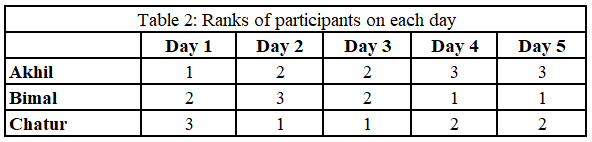
The following information is also known.
1. Chatur always scores in multiples of 3. His score on Day 2 is the unique highest score in the competition. His minimum score is observed only on Day 1, and it matches Akhil’s score on Day 4.
2. The total score on Day 3 is the same as the total score on Day 4.
3. Bimal’s scores are the same on Day 1 and Day 3.
From the 2-day averages and Day 3 Day 4: day totals are 15, 15, 16, 16, 18.
Chatur: Day 2 = 9 (unique highest). His minimum (only on Day 1) must be 3, and his other days are 6. Akhil's Day 4 .
Day 3: Akhil Bimal (total 16). Day 4: Bimal . Bimal's Day 1 Day 3 , so Akhil's Day 1 .
Day 2: Akhil + Bimal with Akhil higher: (5, 1) or (4, 2). Day 5: Akhil + Bimal , Bimal above 6, no 9: (5, 7) or (4, 8).
Totals: Chatur 30; Akhil ; Bimal .
What is Akhil's score on Day 1?
Akhil's Day 1 score .
Who attains the maximum total score?
Chatur scores 30; Akhil at most 25 and Bimal at most 27. Chatur is highest.
What is the minimum possible total score of Bimal?
Bimal minimum .
If the total score of Bimal is a multiple of 3, what is the score of Akhil on Day 2?
Bimal's total is 25, 26 or 27; a multiple of 3 means 27 (, ), so Akhil's Day 2 .
If Akhil attains a total score of 24, then what is the total score of Bimal?
Akhil 24 means : (5, 4) or (4, 5). Either way Bimal .
There are only three female students - Amala, Koli and Rini - and only three male students - Biman, Mathew and Shyamal - in a course. The course has two evaluation components, a project and a test. The aggregate score in the course is a weighted average of the two components, with the weights being positive and adding to 1.
The projects are done in groups of two, with each group consisting of a female and a male student. Both the group members obtain the same score in the project.
The following additional facts are known about the scores in the project and the test.
1. The minimum, maximum and the average of both project and test scores were identical - 40, 80 and 60, respectively.
2. The test scores of the students were all multiples of 10; four of them were distinct and the remaining two were equal to the average test scores.
3. Amala’s score in the project was double that of Koli in the same, but Koli scored 20 more than Amala in the test. Yet Amala had the highest aggregate score.
4. Shyamal scored the second highest in the test. He scored two more than Koli, but two less than Amala in the aggregate.
5. Biman scored the second lowest in the test and the lowest in the aggregate.
6. Mathew scored more than Rini in the project, but less than her in the test.
Project: three pairs with min 40, max 80, average 60, so pair scores are 40, 60, 80. Amala Koli means Amala 80 and Koli 40; Rini 60. Mathew beats Rini, so he's Amala's partner (80).
Test: two 60s plus four distinct values including 40 and 80 summing to 240, i.e. 40, 50, 70, 80. Shyamal 70 (second highest), Biman 50 (second lowest).
Amala − Koli aggregate : .
Koli Amala in the test: (40, 60) or (60, 80). Checking Shyamal Amala , only Amala 60, Koli 80 works, with Shyamal paired with Rini (project 60). Then Mathew 40, Rini 60 in the test, and Biman is with Koli.
Aggregates: Amala 68, Shyamal 66, Koli 64, Rini 60, Mathew 56, Biman 46.
What was Rini’s score in the project?
Rini's project score .
What was the weight of the test component?
.
What was the maximum aggregate score obtained by the students?
Amala: .
What was Mathew’s score in the test?
Mathew's test score .
Which of the following pairs of students were part of the same project team?
i) Amala and Biman
ii) Koli and Mathew
Teams: Amala–Mathew, Rini–Shyamal, Koli–Biman. Neither pair is a team.
Ravi works in an online food-delivery company. After each delivery, customers rate Ravi on each of four parameters - Behaviour, Packaging, Hygiene, and Timeliness, on a scale from 1 to 9. If the total of the four rating points is 25 or more, then Ravi gets a bonus of ₹20 for that delivery. Additionally, a customer may or may not give Ravi a tip. If the customer gives a tip, it is either ₹30 or ₹50.
One day, Ravi made four deliveries - one to each of Atal, Bihari, Chirag, and Deepak, and received a total of ₹120 in bonus and tips. He did not get both a bonus and a tip from the same customer.
The following additional facts are also known.
1. In Timeliness, Ravi received a total of 21 points, and three of the customers gave him the same rating points in this parameter. Atal gave higher rating points than Bihari and Chirag in this parameter.
2. Ravi received distinct rating points in Packaging from the four customers adding up to 29 points. Similarly, Ravi received distinct rating points in Hygiene from the four customers adding up to 26 points.
3. Chirag gave the same rating points for Packaging and Hygiene.
4. Among the four customers, Bihari gave the highest rating points in Packaging, and Chirag gave the highest rating points in Hygiene.
5. Everyone rated Ravi between 5 and 7 in Behaviour. Unique maximum and minimum ratings in this parameter were given by Atal and Deepak respectively.
6. If the customers are ranked based on ratings given by them in individual parameters, then Atal’s rank based on Packaging is the same as that based on Hygiene. This is also true for Deepak.
Timeliness: three equal ratings (Bihari, Chirag and Deepak, since Atal beats Bihari and Chirag) and Atal , with .
Packaging: distinct, sum 29, Bihari highest. Hygiene: distinct, sum 26, Chirag highest, and Chirag's packaging hygiene. Atal's and Deepak's ranks match across the two.
Behaviour: 5–7, Atal the unique 7 and Deepak the unique 5, Bihari and Chirag 6.
Money: ₹120 from ₹20 bonuses (total ) and tips of ₹30/₹50 from the others.
Checking all combinations, only one set of ratings works:
| Customer | Behaviour | Packaging | Hygiene | Timeliness | Total |
|---|---|---|---|---|---|
| Atal | 7 | 5 | 5 | 6 | 23 |
| Bihari | 6 | 9 | 7 | 5 | 27 |
| Chirag | 6 | 8 | 8 | 5 | 27 |
| Deepak | 5 | 7 | 6 | 5 | 23 |
Bihari and Chirag get the bonus (₹40); Atal and Deepak tip ₹80 between them, i.e. ₹30 and ₹50 in some order.
What was the minimum rating that Ravi received from any customer in any parameter?
Lowest rating anywhere: .
The COMPLETE list of customers who gave the maximum total rating points to Ravi is
Bihari and Chirag, 27 each.
What rating did Atal give on Timeliness?
Atal's timeliness: ().
What BEST can be concluded about the tip amount given by Deepak?
Atal and Deepak share ₹80 as 30 + 50: Deepak gave ₹30 or ₹50.
In which parameter did Atal give the maximum rating points to Ravi?
Atal: Behaviour 7 is his highest.
What rating did Deepak give on Packaging?
Deepak's packaging: .
10 players - P1, P2, … , P10 - competed in an international javelin throw event. The number (after P) of a player reflects his rank at the beginning of the event, with rank 1 going to the topmost player. There were two phases in the event with the first phase consisting of rounds 1, 2, and 3, and the second phase consisting of rounds 4, 5, and 6. A throw is measured in terms of the distance it covers (in meters, up to one decimal point accuracy), only if the throw is a ‘valid’ one. For an invalid throw, the distance is taken as zero. A player’s score at the end of a round is the maximum distance of all his throws up to that round. Players are re-ranked after every round based on their current scores. In case of a tie in scores, the player with a prevailing higher rank retains the higher rank. This ranking determines the order in which the players go for their throws in the next round.
In each of the rounds in the first phase, the players throw in increasing order of their latest rank, i.e. the player ranked 1 at that point throws first, followed by the player ranked 2 at that point and so on. The top six players at the end of the first phase qualify for the second phase. In each of the rounds in the second phase, the players throw in decreasing order of their latest rank i.e. the player ranked 6 at that point throws first, followed by the player ranked 5 at that point and so on. The players ranked 1, 2, and 3 at the end of the sixth round receive gold, silver, and bronze medals respectively.
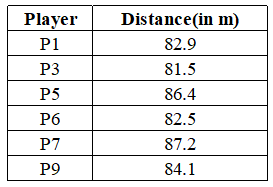
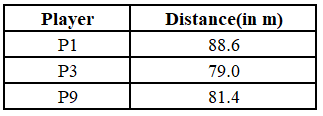
All the valid throws of the event were of distinct distances (as per stated measurement accuracy). The tables below show distances (in meters) covered by all valid throws in the first and the third round in the event.
Distances covered by all the valid throws in the first round
Distances covered by all the valid throws in the third round
The following facts are also known.
i. Among the throws in the second round, only the last two were valid. Both the throws enabled these players to qualify for the second phase, with one of them qualifying with the least score. None of these players won any medal.
ii. If a player throws first in a round AND he was also the last (among the players in the current round) to throw in the previous round, then the player is said to get a double. Two players got a double.
iii. In each round of the second phase, exactly one player improved his score. Each of these improvements was by the same amount.
iv. The gold and bronze medalists improved their scores in the fifth and the sixth rounds respectively. One medal winner improved his score in the fourth round.
v. The difference between the final scores of the gold medalist and the silver medalist, as well as the difference between the final scores of the silver medalist and the bronze medalist was 1.0 m.
After Round 1: P7 87.2, P5 86.4, P9 84.1, P1 82.9, P6 82.5, P3 81.5, then P2, P4, P8, P10 at 0. So P8 and P10 throw last in Round 2, and their throws were the valid ones.
After Round 3, P1 has 88.6. The top four are P1, P7, P5, P9; P8 and P10 qualify above P6 (82.5), one of them 6th (below P9's 84.1).
Medals go to three of P1, P7, P5, P9, with gaps of 1.0 m. Each phase-2 round has one improvement of the same size , all by medallists: gold in Round 5, bronze in Round 6, and a medallist in Round 4.
The fit: gold P7 (Rounds 4 and 5, ), silver P1 88.6, bronze P5 (Round 6).
Doubles: P10 threw last in Round 2; he is first in Round 3 only if his throw beat 87.2 (but stayed below 87.6). P8 is the last qualifier to throw in Round 3 (ranked below P1, so between 82.5 and 82.9) and first in Round 4 as 6th. So P8 and P10 get doubles.
Which two players got the double?
P8 (last qualifier in Round 3, first in Round 4) and P10 (last in Round 2, first in Round 3).
Who won the silver medal?
P1 with 88.6.
Who threw the last javelin in the event?
In Round 6 the top-ranked player throws last: P7 (89.6 after Round 5).
What was the final score (in m) of the silver-medalist?
m.
Which of the following can be the final score (in m) of P8?
P8 is between 82.5 and 82.9: .
By how much did the gold medalist improve his score (in m) in the second phase?
Gold (P7) improved twice by 1.2: m.
Preparing for CAT seriously? Structured courses, live classes and mocks by Dr. Kiran Derle at Target Campus.
Explore courses ↗