How many taps did Clive receive for his question?
Solution
.
Answer: 7
Pure reasoning sets: relationships, tests, decisions and deductions.
Appeared in 7 of 18 slots. Most recent: CAT 2025 Slot 1.
| Year | Slot 1 | Slot 2 | Slot 3 | Sets |
|---|---|---|---|---|
| CAT 2025 | 1 | 1 | 0 | 2 |
| CAT 2024 | 0 | 0 | 0 | 0 |
| CAT 2023 | 1 | 0 | 0 | 1 |
| CAT 2022 | 1 | 0 | 0 | 1 |
| CAT 2021 | 1 | 0 | 2 | 3 |
| CAT 2020 | 0 | 0 | 1 | 1 |
| Total | 4 | 1 | 3 | 8 |
Alia, Badal, Clive, Dilshan, and Ehsaan played a game in which each asks a unique question to all the others and they respond by tapping their feet, either once or twice or thrice. One tap means “Yes”, two taps mean “No”, and three taps mean “Maybe”.
A total of 40 taps were heard across the five questions. Each question received at least one “Yes”, one “No”, and one “Maybe.”
The following information is known.
1. Alia tapped a total of 6 times and received 9 taps to her question. She responded “Yes” to the questions asked by both Clive and Dilshan.
2. Dilshan and Ehsaan tapped a total of 11 and 9 times respectively. Dilshan responded “No” to Badal.
3. Badal, Dilshan, and Ehsaan received equal number of taps to their respective questions.
4. No one responded “Yes” more than twice.
5. No one’s answer to Alia’s question matched the answer that Alia gave to that person’s question. This was also true for Ehsaan.
6. Clive tapped more times in total than Badal.
Each question gets four replies including at least one Yes (1), No (2) and Maybe (3), so it receives 7, 8 or 9 taps.
Received: Alia 9, and Badal = Dilshan = Ehsaan , Clive , with . Only , works.
Alia tapped 6 with Yes to Clive and Dilshan; she can't say Yes again, so she said No to Badal and Ehsaan.
Dilshan tapped 11 with No to Badal, so Maybe to the other three.
Statement 5 (Alia): the No to Alia's question came from Clive (Dilshan said Maybe), and her Yes came from Badal or Ehsaan.
Ehsaan tapped 9, and his reply to Dilshan cannot be Maybe (Dilshan told him Maybe), so it is No. Then his replies to Alia, Badal and Clive add to 7, which forces Maybe, Maybe, Yes.
That fixes: Badal → Alia Yes; Clive → Badal Yes; Badal → Clive No; Clive → Ehsaan No (it can't match Ehsaan's Yes to Clive); Badal → Ehsaan Yes.
Badal and Clive give No and Maybe to Dilshan. Clive taps more than Badal, so Clive says Maybe and Badal says No.
Totals tapped: Alia 6, Badal 6, Clive 8, Dilshan 11, Ehsaan 9.
How many taps did Clive receive for his question?
.
Which two people tapped an equal number of times in total?
Alia and Badal both tapped 6 times.
What was Clive’s response to Ehsaan’s question?
Clive answered No to Ehsaan's question.
How many “Yes” responses were received across all the questions?
Yes replies: Badal→Alia, Clive→Badal, Alia→Clive, Ehsaan→Clive, Alia→Dilshan, Badal→Ehsaan. Total .
There are six spherical balls, B1, B2, B3, B4, B5, and B6, and four circular hoops H1, H2, H3, and H4.
Each ball was tested on each hoop once, by attempting to pass the ball through the hoop. If the diameter of a ball is not larger than the diameter of the hoop, the ball passes through the hoop and makes a “ping”. Any ball having a diameter larger than that of the hoop gets stuck on that hoop and does not make a ping.
The following additional information is known:
1. B1 and B6 each made a ping on H4, but B5 did not.
2. B4 made a ping on H3, but B1 did not.
3. All balls, except B3, made pings on H1.
4. None of the balls, except B2, made a ping on H2.
A ping means ball hoop.
H2: only B2 passes, so B2 is the smallest ball and H2 is smaller than every other ball. H1: everyone except B3 passes, so B3 is the largest ball.
H3: B4 passes, B1 doesn't, so . H4: B1, B6 pass, B5 doesn't, so . And .
Hoops: , so .
Pings: B2 passes all 4; B3 none; B1 on H1, H4 (2); B4 on H1, H3, H4 (3); B5 on H1 only (1); B6 on H1, H4 and maybe H3 (2 or 3).
What was the total number of pings made by B1, B2, and B3?
.
Which of the following statements about the relative sizes of the balls is NOT NECESSARILY true?
B6 and B1 are both at most H4, but their order isn't fixed, so is not necessarily true.
Which of the following statements about the relative sizes of the hoops is true?
.
What BEST can be said about the total number of pings from all the tests undertaken?
or .
Faculty members in a management school can belong to one of four departments - Finance and Accounting (F&A), Marketing and Strategy (M&S), Operations and Quants (O&Q) and Behaviour and Human Resources (B&H). The numbers of faculty members in F&A, M&S, O&Q and B&H departments are 9, 7, 5 and 3 respectively.
Prof. Pakrasi, Prof. Qureshi, Prof. Ramaswamy and Prof. Samuel are four members of the school's faculty who were candidates for the post of the Dean of the school. Only one of the candidates was from O&Q.
Every faculty member, including the four candidates, voted for the post. In each department, all the faculty members who were not candidates voted for the same candidate. The rules for the election are listed below.
1. There cannot be more than two candidates from a single department.
2. A candidate cannot vote for himself/herself.
3. Faculty members cannot vote for a candidate from their own department.
After the election, it was observed that Prof. Pakrasi received 3 votes, Prof. Qureshi received 14 votes, Prof. Ramaswamy received 6 votes and Prof. Samuel received 1 vote. Prof. Pakrasi voted for Prof. Ramaswamy, Prof. Qureshi for Prof. Samuel, Prof. Ramaswamy for Prof. Qureshi and Prof. Samuel for Prof. Pakrasi.
Votes from non-candidates: Pakrasi , Ramaswamy , Qureshi , Samuel 0.
A block of 2 non-candidates is possible only in B&H with one candidate. O&Q has one candidate, so 4 non-candidates.
The other two candidates are in F&A and M&S. Only (F&A 0, M&S 2) lets the blocks split as 5 (M&S → Ramaswamy) and (F&A, O&Q → Qureshi).
No one votes for their own department, so Ramaswamy isn't in M&S and Pakrasi isn't in B&H. The candidates' own votes rule out M&S and . So M&S Pakrasi, Qureshi, and Ramaswamy and Samuel are in O&Q and B&H (either way).
Which two candidates can belong to the same department?
Pakrasi and Qureshi are both in M&S.
Which of the following can be the number of votes that Prof. Qureshi received from a single department?
Qureshi gets F&A's 9 non-candidate votes and O&Q's 4. Only is an option.
If Prof. Samuel belongs to B&H, which of the following statements is/are true?
Statement A: Prof. Pakrasi belongs to M&S.
Statement B: Prof. Ramaswamy belongs to O&Q
If Samuel is in B&H, Ramaswamy is in O&Q, and Pakrasi is in M&S. Both statements are true.
What best can be concluded about the candidate from O&Q?
The O&Q candidate is either Ramaswamy or Samuel.
Which of the following statements is/are true?
Statement A: Non-candidates from M&S voted for Prof. Qureshi.
Statement B: Non-candidates from F&A voted for Prof. Qureshi.
M&S voted for Ramaswamy; F&A voted for Qureshi. Only statement B.
The following facts are known about the goals scored by these four players only. All the questions refer only to the goals scored by these four players.
The management of a university hockey team was evaluating performance of four women players - Amla, Bimla, Harita and Sarita for their possible selection in the university team for next year. For this purpose, the management was looking at the number of goals scored by them in the past 8 matches, numbered 1 through 8. The four players together had scored a total of 12 goals in these matches. In the 8 matches, each of them had scored at least one goal. No two players had scored the same total number of goals.
1. Only one goal was scored in every even numbered match.
2. Harita scored more goals than Bimla.
3. The highest goal scorer scored goals in exactly 3 matches including Match 4 and Match 8.
4. Bimla scored a goal in Match 1 and one each in three other consecutive matches.
5. An equal number of goals were scored in Match 3 and Match 7, which was different from the number of goals scored in either Match 1 or Match 5.
6. The match in which the highest number of goals was scored was unique and it was not Match 5.
Four distinct totals (each at least 1) adding to 12: or .
Bimla scored in Match 1 and in three other consecutive matches, so she has at least 4 goals. Harita has more than Bimla, so the totals are 1, 2, 4, 5: Bimla 4, Harita 5 (the highest scorer). Amla and Sarita have 1 and 2.
Even matches have 1 goal each (4 goals), so odd matches have 8.
Harita scored 5 goals in exactly 3 matches including Matches 4 and 8 (1 goal each), so she scored 3 goals in one odd match.
Bimla's three consecutive matches can't include 4 or 8 (Harita's single goals), so they are 5, 6, 7. Bimla: Matches 1, 5, 6, 7.
Harita's 3-goal match: M3 or M7 would force M3 M7 and break the unique-highest rule or the total. M5 can't be the highest match. So it is Match 1: M1 .
Then with M5 M3: M3 M7 , M5 .
| Match | 1 | 2 | 3 | 4 | 5 | 6 | 7 | 8 |
|---|---|---|---|---|---|---|---|---|
| Goals | 4 | 1 | 1 | 1 | 2 | 1 | 1 | 1 |
| Scorers | B, H(3) | A/S | A/S | H | B, A/S | B | B | H |
Amla and Sarita share the three single goals in Matches 2, 3 and 5 (one has 1, the other 2).
How many goals were scored in Match 7?
Match 7 had only Bimla's goal: .
Which of the following is the correct sequence of goals scored in matches 1, 3, 5 and 7?
Matches 1, 3, 5, 7: .
Which of the following statement(s) is/are true?
Statement-1: Amla and Sarita never scored goals in the same match.
Statement-2: Harita and Sarita never scored goals in the same match.
Matches 2, 3 and 5 each have exactly one goal from Amla or Sarita, so they never score in the same match. Harita scores only in 1, 4, 8 and Sarita only in 2, 3, 5. Both statements are true.
Which of the following statement(s) is/are false?
Statement-1: In every match at least one player scored a goal.
Statement-2: No two players scored goals in the same number of matches.
Every match has at least one goal. Matches scored in: Harita 3, Bimla 4, Amla and Sarita 1 and 2, all different. Both statements are true, so none is false.
If Harita scored goals in one more match as compared to Sarita, which of the following statement(s) is/are necessarily true?
Statement-1: Amla scored goals in consecutive matches.
Statement-2: Sarita scored goals in consecutive matches.
Harita scored in 3 matches, so Sarita scored in 2 (2 goals) and Amla in 1. Sarita's two matches can be , or , so neither statement is necessarily true.
Amudha, Bharatan, Chandran, Dhinesh, Ezhil, Fani and Gowtham are seven people in a town. Any pair of them could either be strangers, acquaintances, or friends. All relationships are mutual. For example, if Amudha is a friend of Bharatan, then Bharatan is also a friend of Amudha. Similarly, if Amudha is a stranger to Bharatan, then Bharatan is also a stranger to Amudha.
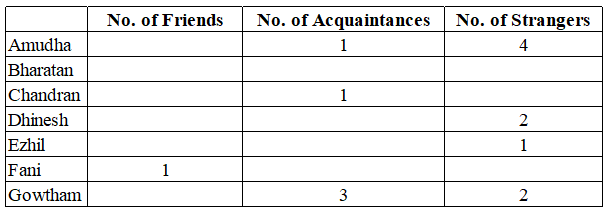
Partial information about the number of friends, acquaintances, and strangers of each of these people among them is given in the table below.
The following additional facts are also known.
1. Amudha, Bharatan, and Chandran are mutual strangers.
2. Amudha, Dhinesh, and Fani are Ezil's friends.
3. Chandran and Gowtham are friends.
4. Every friend of Amudha is an acquaintance of Bharatan, and every acquaintance of Bharatan is a friend of Amudha.
5. Every friend of Bharatan is an acquaintance of Amudha, and every acquaintance of Amudha is a friend of Bharatan.
Amudha has 4 strangers and 1 acquaintance, so 1 friend: Ezhil. Strangers include Bharatan and Chandran.
By facts 4 and 5: Bharatan's acquaintances Amudha's friends Ezhil, and Bharatan's friends Amudha's acquaintances.
Gowtham has 3 acquaintances and 2 strangers, so his only friend is Chandran. Fani's only friend is Ezhil. So neither can be Bharatan's friend, and Amudha's acquaintance is Dhinesh (Bharatan's friend).
Ezhil has 1 stranger and friends Amudha, Dhinesh, Fani. Gowtham's strangers are Amudha and Bharatan, so he's acquainted with Dhinesh, Ezhil, Fani. Then Ezhil's stranger is Chandran.
Dhinesh's 2 strangers are Chandran and Fani. Chandran's one acquaintance is Fani.
| Friends | Acquaintances | Strangers | |
|---|---|---|---|
| Amudha | E | D | B, C, F, G |
| Bharatan | D | E | A, C, F, G |
| Chandran | G | F | A, B, D, E |
| Dhinesh | B, E | A, G | C, F |
| Ezhil | A, D, F | B, G | C |
| Fani | E | C, G | A, B, D |
| Gowtham | C | D, E, F | A, B |
Who are Gowtham’s acquaintances?
Gowtham's acquaintances: Dhinesh, Ezhil and Fani.
Which of these pairs share the same type of relationship?
Bharatan–Ezhil and Fani–Gowtham are both acquaintances.
Who is an acquaintance of Amudha?
Dhinesh.
Who is an acquaintance of Chandran?
Fani.
How many friends does Ezhil have?
Amudha, Dhinesh, Fani: .
How many people are either a friend or a friend-of-a-friend of Ezhil?
Friends: Amudha, Dhinesh, Fani. Their friends add Bharatan (Dhinesh's friend). Total .
Each of the bottles mentioned in this question contains 50 ml of liquid. The liquid in any bottle can be 100% pure content (P) or can have certain amount of impurity (I). Visually it is not possible to distinguish between P and I. There is a testing device which detects impurity, as long as the percentage of impurity in the content tested is 10% or more.
For example, suppose bottle 1 contains only P, and bottle 2 contains 80% P and 20% I. If content from bottle 1 is tested, it will be found out that it contains only P. If content of bottle 2 is tested, the test will reveal that it contains some amount of I. If 10 ml of content from bottle 1 is mixed with 20 ml content from bottle 2, the test will show that the mixture has impurity, and hence we can conclude that at least one of the two bottles has I. However, if 10 ml of content from bottle 1 is mixed with 5 ml of content from bottle 2. the test will not detect any impurity in the resultant mixture.
The device detects impurity only when the tested mixture is at least 10% I. Mixing equal amounts from bottles divides each bottle's impurity percentage by .
5 ml of content from bottle A is mixed with 5 ml of content from bottle B. The resultant mixture, when tested, detects the presence of I. If it is known that bottle A contains only P, what BEST can be concluded about the volume of I in bottle B?
The 10 ml mixture has at least 1 ml of I, all from B's 5 ml. So B is at least 20% I: at least 10 ml of I in its 50 ml.
There are four bottles. Each bottle is known to contain only P or only I. They will be considered to be “collectively ready for despatch” if all of them contain only P. In minimum how many tests, is it possible to ascertain whether these four bottles are “collectively ready for despatch”?
Mix equal amounts from all four bottles. If any bottle is pure I, the mixture is at least 25% I and is detected. test.
There are four bottles. It is known that three of these bottles contain only P, while the remaining one contains 80% P and 20% I. What is the minimum number of tests required to definitely identify the bottle containing some amount of I?
Two bottles mixed equally show 10% if one is impure; three would show only 6.7%.
Test 1: bottles 1 + 2. Test 2: bottles 1 + 3. (Yes, Yes) → 1; (Yes, No) → 2; (No, Yes) → 3; (No, No) → 4.
One test has only two outcomes for four possibilities, so the minimum is .
There are four bottles. It is known that either one or two of these bottles contain(s) only P, while the remaining ones contain 85% P and 15% I. What is the minimum number of tests required to ascertain the exact number of bottles containing only P?
Mix equal amounts of all four. Three impure bottles give (detected); two give (not detected). test.
Three reviewers Amal, Bimal, and Komal are tasked with selecting questions from a pool of 13 questions (Q01 to Q13). Questions can be created by external “subject matter experts” (SMEs) or by one of the three reviewers. Each of the reviewers either approves or disapproves a question that is shown to them. Their decisions lead to eventual acceptance or rejection of the question in the manner described below.
If a question is created by an SME, it is reviewed first by Amal, and then by Bimal. If both of them approve the question, then the question is accepted and is not reviewed by Komal. If both disapprove the question, it is rejected and is not reviewed by Komal. If one of them approves the question and the other disapproves it, then the question is reviewed by Komal. Then the question is accepted only if she approves it.
A question created by one of the reviewers is decided upon by the other two. If a question is created by Amal, then it is first reviewed by Bimal. If Bimal approves the question, then it is accepted. Otherwise, it is reviewed by Komal. The question is then accepted only if Komal approves it. A similar process is followed for questions created by Bimal, whose questions are first reviewed by Komal, and then by Amal only if Komal disapproves it. Questions created by Komal are first reviewed by Amal, and then, if required, by Bimal.
The following facts are known about the review process after its completion.
1. Q02, Q06, Q09, Q11, and Q12 were rejected and the other questions were accepted.
2. Amal reviewed only Q02, Q03, Q04, Q06, Q08, Q10, Q11, and Q13.
3. Bimal reviewed only Q02, Q04, Q06 through Q09, Q12, and Q13.
4. Komal reviewed only Q01 through Q05, Q07, Q08, Q09, Q11, and Q12.
Who reviewed a question shows how it was created:
All three reviewers → SME with a split vote (Q02, Q04, Q08). Only Komal → Bimal's, approved by Komal (Q01, Q05). Amal and Komal → Bimal's, Komal disapproved (Q03, Q11). Bimal and Komal → Amal's, Bimal disapproved (Q07, Q09, Q12). Only Amal → Komal's, approved (Q10). Amal and Bimal → SME with matching votes, or Komal's with Amal disapproving (Q06, Q13).
| Q | Creator | Result | Decisions |
|---|---|---|---|
| 01 | Bimal | Accepted | K yes |
| 02 | SME | Rejected | A/B split, K no |
| 03 | Bimal | Accepted | K no, A yes |
| 04 | SME | Accepted | A/B split, K yes |
| 05 | Bimal | Accepted | K yes |
| 06 | SME or Komal | Rejected | A no, B no |
| 07 | Amal | Accepted | B no, K yes |
| 08 | SME | Accepted | A/B split, K yes |
| 09 | Amal | Rejected | B no, K no |
| 10 | Komal | Accepted | A yes |
| 11 | Bimal | Rejected | K no, A no |
| 12 | Amal | Rejected | B no, K no |
| 13 | SME or Komal | Accepted | A yes, B yes (SME) or A no, B yes (Komal) |
How many questions were DEFINITELY created by Amal?
Q07, Q09, Q12: .
How many questions were DEFINITELY created by Komal?
Q10: .
How many questions were DEFINITELY created by the SMEs?
Q02, Q04, Q08: .
How many questions were DEFINITELY disapproved by Bimal?
Q06, Q07, Q09, Q12: . (In Q02, Q04, Q08 it could have been Amal who disapproved.)
The approval ratio of a reviewer is the ratio of the number of questions (s)he approved to the number of questions (s)he reviewed. Which option best describes Amal’s approval ratio?
Amal reviewed 8. Definite approvals: Q03, Q10. Possible: Q02, Q04, Q08 (whichever split), Q13. Approvals range from 2 to 6: ratio between 0.25 and 0.75.
How many questions created by Amal or Bimal were disapproved by at least one of the other reviewers?
Amal's: Q07, Q09, Q12 (Bimal disapproved). Bimal's: Q03, Q11 (Komal disapproved). Total .
Sixteen patients in a hospital must undergo a blood test for a disease. It is known that exactly one of them has the disease. The hospital has only eight testing kits and has decided to pool blood samples of patients into eight vials for the tests. The patients are numbered 1 through 16, and the vials are labelled A, B, C, D, E, F, G, and H. The following table shows the vials into which each patient’s blood sample is distributed.
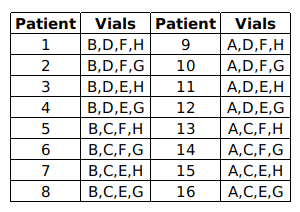
If a patient has the disease, then each vial containing his/her blood sample will test positive. If a vial tests positive, one of the patients whose blood samples were mixed in the vial has the disease. If a vial tests negative, then none of the patients whose blood samples were mixed in the vial has the disease.
Every patient is in exactly one vial from each pair: A or B, C or D, E or F, G or H. So the four results give a unique code.
A: patients 9–16, B: 1–8. C: 5–8, 13–16, D: the rest. E: 3, 4, 7, 8, 11, 12, 15, 16, F: the rest. G: even patients, H: odd patients.
Exactly one vial in each pair tests positive.
Suppose vial C tests positive and vials A, E and H test negative. Which patient has the disease?
C positive, A, E, H negative, so B, C, F, G positive: Patient 6.
Suppose vial A tests positive and vials D and G test negative. Which of the following vials should we test next to identify the patient with the disease?
A, C, H positive (D, G negative): Patient 13 (A, C, F, H) or 15 (A, C, E, H). Testing E (or F) settles it.
Which of the following combinations of test results is NOT possible?
C and D can't both be negative; one of each pair is always positive. So A is impossible.
Suppose one of the lab assistants accidentally mixed two patients' blood samples before they were distributed to the vials. Which of the following correctly represents the set of all possible numbers of positive test results out of the eight vials?
If the mixed pair doesn't include the patient with the disease: 4 positives. If it does, positives are the union of both codes: , where (1–4) is the number of pairs in which the codes differ, giving 5 to 8. So .
Preparing for CAT seriously? Structured courses, live classes and mocks by Dr. Kiran Derle at Target Campus.
Explore courses ↗