What is the row number which has the least sum of numbers placed in that row?
Solution
Row sums: 29, 15 or 16, 9 or 10, and 1. Row is the least.
Answer: 4
Puzzles on grids or matrices with row and column conditions.
Appeared in 5 of 18 slots. Most recent: CAT 2024 Slot 2.
| Year | Slot 1 | Slot 2 | Slot 3 | Sets |
|---|---|---|---|---|
| CAT 2025 | 0 | 0 | 0 | 0 |
| CAT 2024 | 0 | 1 | 0 | 1 |
| CAT 2023 | 1 | 1 | 0 | 2 |
| CAT 2022 | 0 | 0 | 0 | 0 |
| CAT 2021 | 0 | 0 | 0 | 0 |
| CAT 2020 | 0 | 1 | 1 | 2 |
| Total | 1 | 3 | 1 | 5 |
The numbers 1, 2, 3, 4, 5, 6, 7, 8, 9, and 10 are placed in ten slots of the following grid based on the conditions below.
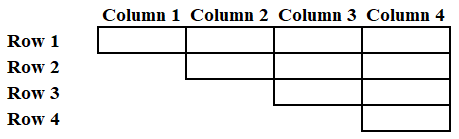
1. Numbers in any row appear in an increasing order from left to right.
2. Numbers in any column appear in a decreasing order from top to bottom.
3. 1 is placed either in the same row or in the same column as 10.
4. Neither 2 nor 3 is placed in the same row or in the same column as 10.
5. Neither 7 nor 8 is placed in the same row or in the same column as 9.
6. 4 and 6 are placed in the same row.
Row 1 has columns 1–4, Row 2 has 2–4, Row 3 has 3–4 and Row 4 has only column 4. Rows increase to the right and columns decrease downwards.
R1C4 is larger than everything in its row and column, and every other slot is below it in some chain, so R1C4 . 1 must share a row or column with 10, and the smallest slots are R1C1 or R4C4.
9 is at R1C3 or R2C4. If 9 were at R2C4, 8 and 7 would be forced into row 1, and 2, 3, 4, 6 could not be placed. So 9 is at R1C3.
Then 8 must be R2C4 (not in row 1 or column 3) and 7 must be R3C4.
4 and 6 must share a row, and only row 1 has two free slots: R1C1 , R1C2 . So 1 is at R4C4, R2C3 , and 2, 3 fill R2C2 and R3C3 in either order.
| Row | C1 | C2 | C3 | C4 |
|---|---|---|---|---|
| 1 | 4 | 6 | 9 | 10 |
| 2 | – | 2/3 | 5 | 8 |
| 3 | – | – | 3/2 | 7 |
| 4 | – | – | – | 1 |
What is the row number which has the least sum of numbers placed in that row?
Row sums: 29, 15 or 16, 9 or 10, and 1. Row is the least.
Which of the following statements MUST be true?
I. 10 is placed in a slot in Row 1.
II. 1 is placed in a slot in Row 4.
10 is in Row 1 and 1 is in Row 4: both statements are true.
Which of the following statements MUST be true?
I. 2 is placed in a slot in Column 2.
II. 3 is placed in a slot in Column 3.
2 and 3 can swap between R2C2 and R3C3, so neither statement must hold.
For how many slots in the grid, placement of numbers CANNOT be determined with certainty?
Only R2C2 and R3C3 are uncertain: slots.
What is the sum of the numbers placed in Column 4?
Column 4: .
The schematic diagram below shows 12 rectangular houses in a housing complex. House numbers are mentioned in the rectangles representing the houses. The houses are located in six columns - Column-A through Column-F, and two rows - Row-1 and Row-2. The houses are divided into two blocks - Block XX and Block YY. The diagram also shows two roads, one passing in front of the houses in Row-2 and another between the two blocks.
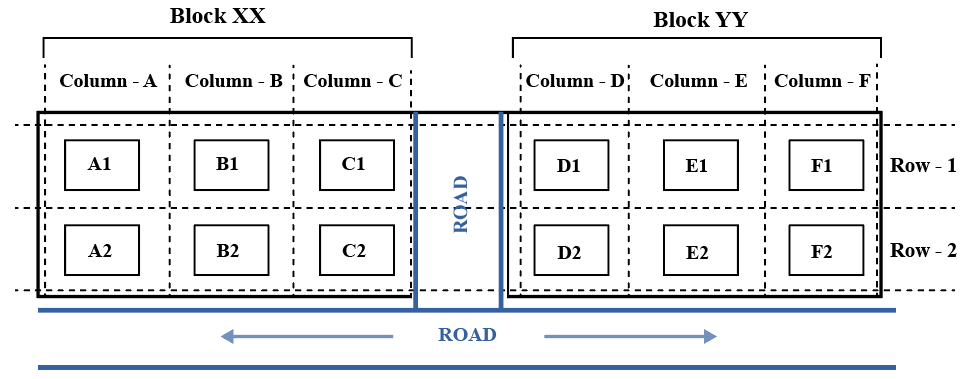
Some of the houses are occupied. The remaining ones are vacant and are the only ones available for sale.
The road adjacency value of a house is the number of its sides adjacent to a road. For example, the road adjacency values of C2, F2, and B1 are 2, 1, and 0, respectively. The neighbour count of a house is the number of sides of that house adjacent to occupied houses in the same block. For example, E1 and C1 can have the maximum possible neighbour counts of 3 and 2, respectively.
The base price of a vacant house is Rs. 10 lakhs if the house does not have a parking space, and Rs. 12 lakhs if it does. The quoted price (in lakhs of Rs.) of a vacant house is calculated as (base price) + 5 × (road adjacency value) + 3 × (neighbour count). The following information is also known.
1. The maximum quoted price of a house in Block XX is Rs. 24 lakhs. The minimum quoted price of a house in block YY is Rs. 15 lakhs, and one such house is in Column-E.
2. Row-1 has two occupied houses, one in each block.
3. Both houses in Column-E are vacant. Each of Column-D and Column-F has at least one occupied house.
4. There is only one house with parking space in Block YY.
Road adjacency: Row-2 houses touch the front road (1); C and D touch the middle road (+1). So C2 and D2 have 2; C1, D1, A2, B2, E2, F2 have 1; A1, B1, E1, F1 have 0.
Block YY's minimum price of 15 is in column E. E2 would need a neighbour count of 0, which leaves no room for occupied houses in D and F with only one occupied in Row 1. So it is E1: parking (12) plus neighbour count 1. E1 is YY's only parking house.
Block XX: a price of 24 is reachable only by B2 (no parking, road 1, neighbour count 3). So B2 is vacant with A2, B1, C2 occupied; A1 and C1 are vacant.
Block YY: if D1 were occupied, F1 would be vacant with a price of 13 (< 15). So F1 is occupied, D1 is vacant and D2 is occupied. F2 may be vacant or occupied.
How many houses are vacant in Block XX?
Vacant in XX: A1, C1, B2, i.e. .
Which of the following houses is definitely occupied?
B1 must be occupied (for B2 to reach 24).
Which of the following options best describes the number of vacant houses in Row-2?
Row 2 vacant: B2, E2, and F2 if it's vacant: or .
What is the maximum possible quoted price (in lakhs of Rs.) for a vacant house in Column-E?
E2: when D2 and F2 are both occupied.
Which house in Block YY has parking space?
E1 is the house with parking in Block YY.
There are nine boxes arranged in a 3×3 array as shown in Tables 1 and 2. Each box contains three sacks. Each sack has a certain number of coins, between 1 and 9, both inclusive.
The average number of coins per sack in the boxes are all distinct integers. The total number of coins in each row is the same. The total number of coins in each column is also the same.
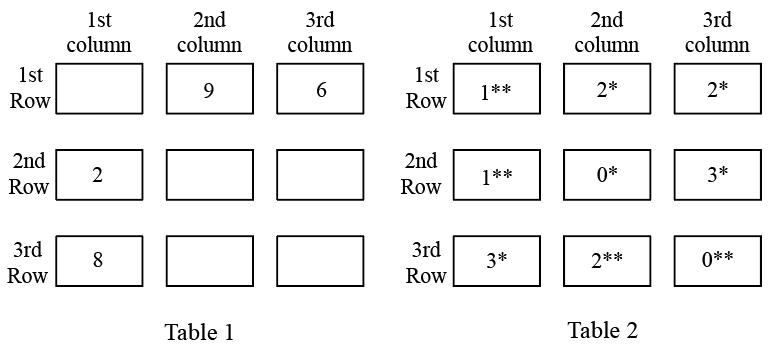
Table 1 gives information regarding the median of the numbers of coins in the three sacks in a box for some of the boxes. In Table 2 each box has a number which represents the number of sacks in that box having more than 5 coins. That number is followed by a * if the sacks in that box satisfy exactly one among the following three conditions, and it is followed by ** if two or more of these conditions are satisfied.
i) The minimum among the numbers of coins in the three sacks in the box is 1.
ii) The median of the numbers of coins in the three sacks is 1.
iii) The maximum among the numbers of coins in the three sacks in the box is 9.
The nine box averages are distinct integers from 1 to 9 (sum 45). Rows have equal totals and columns have equal totals, so each row and column of averages sums to 15 and each row holds 45 coins.
Average 1 is three 1-coin sacks ("0**"): R3C3. Average 9 is three 9s ("3*", median not 8): R2C3. Then R1C3 .
R3C1 (median 8, "3*") must be , average 8, so R3C2 .
The remaining averages 2, 3, 4, 7 fit only as R1: 3, 7; R2: 4, 2.
| Box | Avg | Sacks |
|---|---|---|
| R1C1 | 3 | 1, 1, 7 |
| R1C2 | 7 | 3, 9, 9 |
| R1C3 | 5 | 1, 6, 8 |
| R2C1 | 4 | 1, 2, 9 |
| R2C2 | 2 | 1, 2, 3 |
| R2C3 | 9 | 9, 9, 9 |
| R3C1 | 8 | 7, 8, 9 |
| R3C2 | 6 | 1, 8, 9 |
| R3C3 | 1 | 1, 1, 1 |
What is the total number of coins in all the boxes in the row?
Each row holds coins.
How many boxes have at least one sack containing 9 coins?
Boxes with a 9: R1C2, R2C1, R2C3, R3C1, R3C2, i.e. .
For how many boxes are the average and median of the numbers of coins contained in the three sacks in that box the same?
Average = median: R2C2, R2C3, R3C1, R3C3, i.e. .
How many sacks have exactly one coin?
Sacks with 1 coin: .
In how many boxes do all three sacks contain different numbers of coins?
All different: R1C3, R2C1, R2C2, R3C1, R3C2, i.e. .
Twenty five coloured beads are to be arranged in a grid comprising of five rows and five columns. Each cell in the grid must contain exactly one bead. Each bead is coloured either Red, Blue or Green. While arranging the beads along any of the five rows or along any of the five columns, the rules given below are to be followed:
1. Two adjacent beads along the same row or column are always of different colours.
2. There is at least one Green bead between any two Blue beads along the same row or column.
3. There is at least one Blue and at least one Green bead between any two Red beads along the same row or column.
Every unique, complete arrangement of twenty five beads is called a configuration.
In any row or column: neighbours differ, two Blues need a Green between them, and two Reds need both a Blue and a Green between them.
So two Reds in a line are at least 3 apart: a line of 5 holds at most 2 Reds, at positions 1 & 4, 1 & 5 or 2 & 5, never in the middle.
Example with 9 Reds:
| R | B | G | R | B |
|---|---|---|---|---|
| G | R | B | G | R |
| B | G | R | B | G |
| R | B | G | R | B |
| G | R | B | G | R |
The total number of possible configurations using beads of only two colours is:
Red with one other colour fails (Reds need both B and G between them). Blue and Green alternate in a checkerboard, in ways.
What is the maximum possible number of Red beads that can appear in any configuration?
10 Reds would need exactly 2 in every row, and a row with 2 Reds has none in column 3, leaving column 3 empty of Reds, a contradiction. 9 is achievable (example above).
What is the minimum number of Blue beads in any configuration?
Without a Blue, a row alternates Red and Green and two Reds would have no Blue between them, so every row needs a Blue (at least 5). Checking shows 5 is impossible; 6 works, e.g. rows RBGRG, BGRGB, GRGBG, RGBGR, GBGRG.
Two Red beads have been placed in ‘second row, third column’ and ‘third row, second column’. How many more Red beads can be placed so as to maximise the number of Red beads used in the configuration?
With Reds fixed at (2, 3) and (3, 2), the maximum is 8 Reds, so more.
A farmer had a rectangular land containing 205 trees. He distributed that land among his four daughters - Abha, Bina, Chitra and Dipti by dividing the land into twelve plots along three rows (X,Y,Z) and four Columns (1,2,3,4) as shown in the figure below:
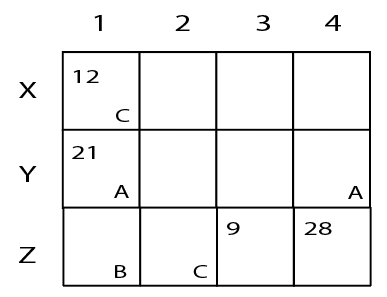
The plots in rows X, Y, Z contained mango, teak and pine trees respectively. Each plot had trees in non-zero multiples of 3 or 4 and none of the plots had the same number of trees. Each daughter got an even number of plots. In the figure, the number mentioned in top left corner of a plot is the number of trees in that plot, while the letter in the bottom right corner is the first letter of the name of the daughter who got that plot (For example, Abha got the plot in row Y and column 1 containing 21 trees). Some information in the figure got erased, but the following is known:
1. Abha got 20 trees more than Chitra but 6 trees less than Dipti.
2. The largest number of trees in a plot was 32, but it was not with Abha.
3. The number of teak trees in Column 3 was double of that in Column 2 but was half of that in Column 4.
4. Both Abha and Bina got a higher number of plots than Dipti.
5. Only Bina, Chitra and Dipti got corner plots.
6. Dipti got two adjoining plots in the same row.
7. Bina was the only one who got a plot in each row and each column.
8. Chitra and Dipti did not get plots which were adjacent to each other (either in row / column / diagonal).
9. The number of mango trees was double the number of teak trees.
Plots: Dipti has 2 (adjoining in a row) and fewer than Abha and Bina; all even, total 12: Abha 4, Bina 4, Chitra 2 (X1, Z2), Dipti 2.
Dipti can't touch Chitra's X1 or Z2: only X3–X4 works. Corners go only to Bina, Chitra and Dipti, so Z4 is Bina's. Bina has a plot in every row and column: Z1, Z4, X2, Y3. Abha: Y1, Y2, Y4, Z3.
Teak: Y2 , Y3 , Y4 . Distinct multiples of 3 or 4, and 12 is taken: (16 is fine; would give Abha 32).
Abha , so Chitra (Z2 ) and Dipti .
Teak , mango : X2 X2 . Pine : Z1 .
The 32-tree plot must be Dipti's: X3, X4 are 32 and 24 in some order.
| Row | 1 | 2 | 3 | 4 |
|---|---|---|---|---|
| X (mango) | 12 C | 30 B | 32/24 D | 24/32 D |
| Y (teak) | 21 A | 4 A | 8 B | 16 A |
| Z (pine) | 3 B | 18 C | 9 A | 28 B |
How many mango trees were there in total?
Mango .
Which of the following is the correct sequence of trees received by Abha, Bina, Chitra and Dipti in that order?
Abha 50, Bina , Chitra 30, Dipti 56.
How many pine trees did Chitra receive?
Chitra's pine plot Z2: .
Who got the plot with the smallest number of trees and how many trees did that plot have?
Smallest: Z1, Bina's, with 3 trees.
Which of the following statements is NOT true?
Bina's pine trees: , not 32. (Chitra mango 12, Abha teak , Dipti mango 56 are all true.)
Which column had the highest number of trees?
Column totals: 1: 36, 2: 52, 3: 49 or 41, 4: 68 or 76. Column 4.
Preparing for CAT seriously? Structured courses, live classes and mocks by Dr. Kiran Derle at Target Campus.
Explore courses ↗