What is the number of the chair initially occupied by Bashir?
Solution
Bashir started on chair .
Answer: 4
Linear, circular and positional arrangements built from a set of clues.
Appeared in 3 of 18 slots. Most recent: CAT 2025 Slot 1.
| Year | Slot 1 | Slot 2 | Slot 3 | Sets |
|---|---|---|---|---|
| CAT 2025 | 1 | 0 | 1 | 2 |
| CAT 2024 | 0 | 0 | 0 | 0 |
| CAT 2023 | 0 | 0 | 0 | 0 |
| CAT 2022 | 0 | 0 | 0 | 0 |
| CAT 2021 | 0 | 0 | 0 | 0 |
| CAT 2020 | 0 | 1 | 0 | 1 |
| Total | 1 | 1 | 1 | 3 |
A round table has seven chairs around it. The chairs are numbered 1 through 7 in a clockwise direction. Four friends, Aslam, Bashir, Chhavi, and Davies, sit on four of the chairs. In the starting position, Aslam and Chhavi are sitting next to each other, while for Bashir as well as Davies, there are empty chairs on either side of the chairs that are sitting on.
The friends take turns moving either clockwise or counterclockwise from their chair. The friend who has to move in a turn occupies the first empty chair in whichever direction (s)he chooses to move. Aslam moves first (Turn 1), followed by Bashir, Chhavi, and Davies (Turns 2, 3, and 4, respectively). Then Aslam moves again followed by Bashir, and Chhavi (Turns 5, 6, and 7, respectively).
The following information is known
1. The four friends occupy adjacent chairs only at the end of Turn 2 and Turn 6.
2. Davies occupies Chair 2 after Turn 1 and Chair 4 after Turn 5, and Chhavi occupies Chair 7 after Turn 2.
Davies is at chair 2 after Turn 1 and Chhavi at chair 7 after Turn 2. Neither has moved by then, so these are their starting chairs.
Davies has empty chairs on both sides, so chairs 1 and 3 are empty. Aslam sits next to Chhavi (7) but not at 1, so Aslam is at 6. Bashir needs empty chairs on both sides, which leaves chair 4 (3 and 5 empty).
Start: A6, B4, C7, D2 (empty: 1, 3, 5).
Turn 1: Aslam goes to 1 or 5. After Turn 2 all four must be adjacent; this works only if Aslam goes to 1 and Bashir to 3: chairs 7, 1, 2, 3.
Turn 3: Chhavi goes to 4 (clockwise) or 6 (counter-clockwise). Davies must reach chair 4 in Turn 4, so Chhavi goes to 6 and Davies moves clockwise to 4.
After Turn 4: A1, B3, C6, D4.
Turn 5: Aslam goes to 2 or 7. After Turn 6 all four are adjacent again; only Aslam to 7 and Bashir to 5 works: chairs 4, 5, 6, 7.
Turn 7: Chhavi leaves 6 (to 1 or 3). Bashir at 5 then has Davies (4) on one side and an empty chair (6) on the other.
What is the number of the chair initially occupied by Bashir?
Bashir started on chair .
Who sits on the chair numbered 4 at the end of Turn 3?
After Turn 3, Chhavi moved to chair 6 and Davies is still at 2, so chair 4 is empty: no one.
Which of the chairs are occupied at the end of Turn 6?
After Turn 6: Davies 4, Bashir 5, Chhavi 6, Aslam 7, i.e. chairs 4, 5, 6 and 7.
Which of the following BEST describes the friends sitting on chairs adjacent to the one occupied by Bashir at the end of Turn 7?
After Turn 7, Chhavi has left chair 6, so Bashir (chair 5) has only Davies (chair 4) next to him.
Seven children, Aarav, Bina, Chirag, Diya, Eshan, Farhan, and Gaurav, are sitting in a circle facing inside (not necessarily in the same order) and playing a game of 'Passing the Buck'.
The game is played over 10 rounds. In each round, the child holding the Buck must pass it directly to a child sitting in one of the following positions:
• Immediately to the left;
• Immediate to the right;
• Second to the left; or
• Second to the right.
The game starts with Bina passing the Buck and ends with Chirag receiving the Buck. The table below provides some information about the pass types and the child receiving the Buck. Some information is missing and labelled as '?'.
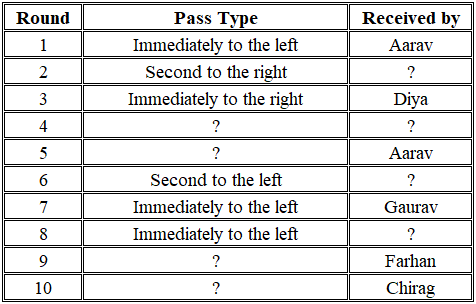
Number the seats with Bina at 0 and "left" as (so right is ). A pass moves or seats.
Round 1 (left 1): Aarav . Round 2 (right 2): receiver at . Round 3 (right 1): Diya .
Round 6: Aarav passes left 2 to seat 3. Round 7 (left 1): Gaurav . Round 8 (left 1): seat 5 = Diya.
Round 9: Diya (5) passes to Farhan, so Farhan is at 3 or 6. Round 10: Farhan passes to Chirag. From seat 6 no free seat is within 2 steps, so Farhan , Chirag , Eshan .
Seating (going left from Bina): Bina, Aarav, Chirag, Farhan, Gaurav, Diya, Eshan.
Rounds 4–5 (Diya → ? → Aarav): via Eshan (left 1, left 2), via Bina (left 2, left 1) or via Farhan (right 2, right 2).
Who is sitting immediately to the right of Bina?
Immediately to Bina's right (seat 6) is Eshan.
Who is sitting third to the left of Eshan?
Three seats to Eshan's left: , which is Chirag.
For which of the following pass types can the total number of occurrences be uniquely determined?
"Immediately to the right" occurs in rounds 3 and 10 only; none of the round 4–5 options use it. So its count (2) is fixed.
For which of the following children is it possible to determine how many times they received the Buck?
Gaurav receives only in round 7 (none of the round-4 options is Gaurav), so his count is known: 1.
A shopping mall has a large basement parking lot with parking slots painted in it along a single row. These slots are quite narrow; a compact car can fit in a single slot but an SUV requires two slots. When a car arrives, the parking attendant guides the car to the first available slot from the beginning of the row into which the car can fit.
For our purpose, cars are numbered according to the order in which they arrive at the lot. For example, the first car to arrive is given a number 1, the second a number 2, and so on. This numbering does not indicate whether a car is a compact or an SUV. The configuration of a parking lot is a sequence of the car numbers in each slot. Each single vacant slot is represented by letter V.
For instance, suppose cars numbered 1 through 5 arrive and park, where cars 1, 3 and 5 are compact cars and 2 and 4 are SUVs. At this point, the parking lot would be described by the sequence 1, 2, 3, 4, 5. If cars 2 and 5 now vacate their slots, the parking lot would now be described as 1, V, V, 3, 4. If a compact car (numbered 6) arrives subsequently followed by an SUV (numbered 7), the parking lot would be described by the sequence 1, 6, V, 3, 4, 7.
Answer the following questions INDEPENDENTLY of each other.
Each car takes the first gap from the start that fits it (1 slot for a compact, 2 for an SUV).
Initially cars numbered 1, 2, 3, and 4 arrive among which 1 and 4 are SUVs while 2 and 3 are compact cars. Car 1 then leaves, followed by the arrivals of car 5 (a compact car) and car 6 (an SUV). Car 4 then leaves. Then car 7 (an SUV) and car 8 (a compact car) arrive. At this moment, which among the following numbered car is parked next to car 3?
1 (SUV, slots 1–2), 2 (3), 3 (4), 4 (SUV, 5–6). Car 1 leaves; 5 takes slot 1; 6 (SUV) goes to 7–8. Car 4 leaves; 7 (SUV) takes 5–6; 8 takes slot 2.
Row: 5, 8, 2, 3, 7, 6. Car 3's neighbours are 2 and 7.
Suppose eight cars have arrived, of which two have left. Also suppose that car 4 is a compact and car 7 is an SUV. Which of the following is a POSSIBLE current configuration of the parking lot?
Option D works: cars 1–6 compact park in order, 7 (SUV) after them. Cars 1 and 4 leave; car 8 takes slot 1, leaving slot 4 vacant: 8, 2, 3, V, 5, 6, 7.
In the other options a later car sits ahead of an earlier one in a gap that the earlier car would have taken first.
Suppose the sequence at some point of time is 4, 5, 6, V, 3. Which of the following is NOT necessarily true?
The space before car 3 was held by cars 1 and 2 (at most 4 slots). It now holds 4, 5, 6 and one V, so it is exactly 4 slots: 1 and 2 were SUVs and 4, 5, 6 are compacts. Car 3's size is not fixed.
Suppose that car 4 is not the first car to leave and that the sequence at a time between the arrival of the car 7 and car 8 is V, 7, 3, 6, 5. Then which of the following statements MUST be false?
Car 6 now sits where car 4 was, so 6 arrived after 4 left, and someone (1 or 2) left before 4. That gap near the front was free when 6 arrived. A compact 6 would have parked there, so car 6 being a compact must be false.
Preparing for CAT seriously? Structured courses, live classes and mocks by Dr. Kiran Derle at Target Campus.
Explore courses ↗